Surprised By Grief

Did you first feel it when your favorite toy broke, or your doll went missing? Maybe when you cut that doll’s hair and realized it didn’t grow back like yours? Was it when the gray cat with the white M between its ears crawled beneath your family’s Pontiac for warmth in the dead of winter, and your father backed over it on the way to church?

Was it when your mother told you, again, that she couldn’t play dolls play jacks play school because her insulin was too low? Or that she couldn’t do much at all when she came home from the hospital after the first second third heart attack? Was it when you lay small in a hospital bed yourself, small at age seven ten twelve even seventeen, always small because hospitals make humans small no matter their size, and gave yourself over to the surgeons who would make you better by first making you worse?

Was it when your first best friend moved away to California, or your pen pal stopped writing? Or when your family stopped being invited to your cousins’ house for Christmas? Was it when you were told you weren’t good enough for the team? And later, the choir? Or maybe it was that time your friend told a friend that you liked a guy and you heard the guy had said, I’m not going to prom with a fatso, and suddenly the person you thought you were no longer was—and would never be.

Or maybe it was when you first sat awkwardly in an office chair in a conference room—because office chairs make everyone feel wrong sized—in a green polyester suit made for someone ten years older than you, and knew, just as they did before you even began, that you wouldn’t get the job? Or have you been lucky and none of those things ever happened at all? Or they happened, but you called it something else. Not ready to call it by its name.

Most likely, don’t you think, it’s when the family dog died? Or the first dog you and he brought home together to your first house? Perhaps you had to wait for it until you signed the papers, because he no longer wanted what you both had wanted and you still did.

Or until she was born and you realized you felt nothing but it.

Or when he got sick just before he turned two and was never the same after the seizure? When you learned you’d lost the boy you thought he would be, and it never let you forget him.

Certainly when you were two states away and your father was rushed to the hospital, and you were ready to jump into the car, only to learn that he was already gone?

Maybe it simply comes along with age, like sore knees. As the days speed by and you find you can’t catch them in your hand, and maybe no longer in your memory either. Likely it’s when you finally know you can’t give everyone everything they need. Not him. Not her. Not them. You couldn’t give anyone a life without it. Least of all yourself.

You should have known, but couldn’t until you did, that you can only lose anything once. Still, each loss arrives new, though none of them arrives alone.
On the Surface

Mark is hosting Dungeons and Dragons tonight. Since taking disability after cancer treatment, D&D is Mark’s most effective treatment against the depression that can sneak up on him if he doesn’t arm himself with a purpose. Noah likes to sit with the gamers (Noah signs “friends” by alternating his index fingers, laying one over the other) at the card tables set up on the back porch. When the players laugh, Noah laughs, though he doesn’t understand what they are saying, why what they are saying is funny. Occasionally he takes a turn rolling the dice, but usually he watches his iPad, one ear on the conversation, waiting for words he recognizes, waiting for laughter.

Tonight Noah has been given a stack of blank copier paper and a blue highlighter. He bends close over his work like a jeweler inspecting a tray of diamonds. His nose almost touches the paper, he is both so intent but also so almost-blind. We still don’t understand his vision issues. He is significantly near-sighted, but being close to a screen or book also helps focus his eyes, still the nystagmus that makes his eyes flicker and dodge. A variety of examinations by a variety of experts have yielded no concrete answers, no applicable strategies. Some tell us to try glasses; some say glasses won’t really help and will only confuse his adapting perceptions. Noah can’t tell us much. He just adapts.

I have walked past the door to the porch several times to check if he’s being disruptive to the game, but he is sitting quietly next to Mark, diligently drawing. I post a picture on Facebook of him in such studious pose, label it: Dungeon Master’s Apprentice. The picture gets many likes. But that captured moment is like so many: on the face of it, Noah is accomplishing something that looks so like what other children are doing. I post a picture of him riding a horse like he is taking a lesson, but it is hippotherapy. I post a picture of us at the pool, but after years of lessons he still cannot swim and we stay in the shallower end. I post a video of Noah ‘running’ the 50 yard dash at a track and field event for his school district’s special needs children. He crosses the finish line though he comes in last, and I am proud because he mostly stayed in his lane, didn’t fall, and ran the whole length without an adult to guide him. But that is not competition; that is participation. And for us, it is enough, but it isn’t what it appears to be.

When I share pictures like these, usually adorned with a clever quip or positive message, I am sharing my son, and my love for my son, and our adventures as a family, with my friends and our family and many acquaintances. This is as it should be. But each time I share these pictures I am also lying. The lie is the one I tell myself in trying to convince myself that my heart doesn’t ache with sadness over the limitations of Noah’s accomplishments documented as celebrations.

I know I am not alone in telling this lie. Social media is full of them. Lies of omission told by the abused, the abusers, the lost, the lonely, the insecure, the in-debt, and the unexceptional. What we present is not what we are. What we present is only what we wish for.

At 9pm I decide it’s time to retrieve Noah from the porch despite his diligent tasking. His face and hands are littered in blue highlighter graffiti. He grabs for his stack of papers, maybe 7 or 8 sheets, says, “Wook!”, proud of his art. I oooh and ahh, and I try so very hard to ignore–no, transcend–the fact that every sheet is covered with roughly-drawn circles, the only shape in 13 years he has learned to draw. Pages and pages of almost-circles.

There should be a word for this feeling of almost. Bittersweet feels too tender, a word for reverie. I want a word that is pride and sorrow intertwined. I want a word, a fresh addition to the limits of language, so I can claim this state. At the same time, I berate myself, think a better person–a better mother–would have by now shed her sorrow, managed her disappointment, and internalized the optimistic messaging she posts along with her Facebook photos. I adore my child, and I am so proud of his half-words, and small gains, and his pages of almost-circles, but I too remain almost-complete, my mother-heart more break than burst.

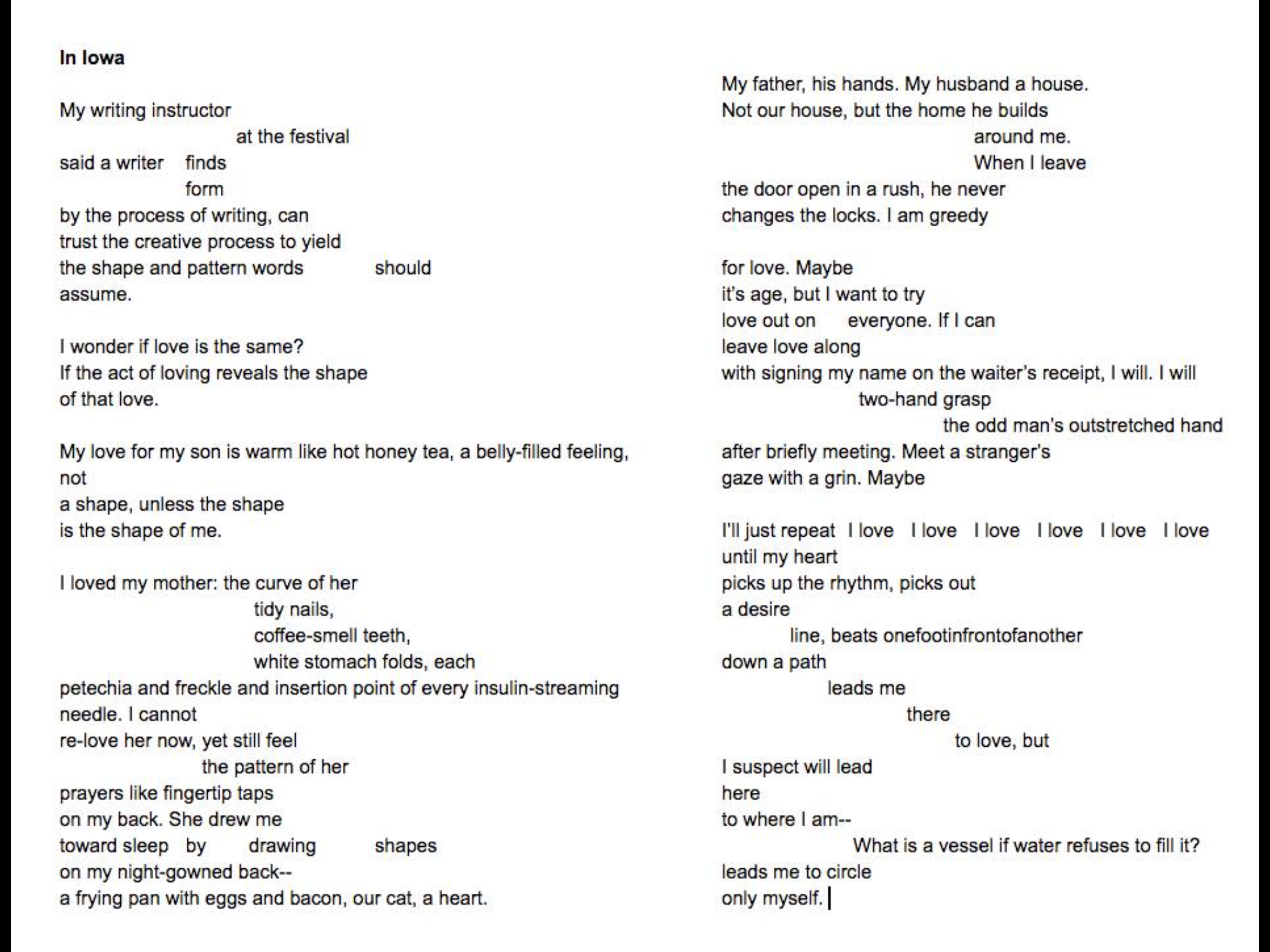
In Iowa (Two Ways)

My writing instructor at the festival said a write finds form by the process of writing, can trust the creative process to yield the shape and pattern words should assume. I wonder if love is the same? If the act of loving reveals the shape of that love.

My love for my son is warm like hot honey tea, a belly-filled feeling, not a shape, unless the shape is the shape of me. I loved my mother: the curve of her tidy nails, coffee-smell teeth, white stomach folds, each petechia and freckle and insertion point of every insulin-streaming needle. I cannot re-love her now, yet still feel the pattern of her prayers like fingertip taps on my back. She drew me toward sleep by drawing shapes on my night-gowned back–a frying pan with eggs and bacon, our cat, a heart. My father, his hands. My husband a house. Not our house, but the home he builds around me. When I leave the door open in a rush, he never changes the locks.

I am greedy for love. Maybe it’s age, but I want to try love out on everyone. If I can leave love along with signing my name on the waiter’s receipt, I will. I will two-hand grasp the odd man’s outstretched hand after briefly meeting. Meet a stranger’s gaze with a grin. Maybe I’ll just repeat I love I love I love I love I love I love until my heart picks up the rhythm, picks out a desire line, beats one foot in front of another down a path leads me there to love, but I suspect will lead here to where I am. — What is a vessel if water refuses to fill it? — leads me to circle only myself.